 Hanyu
Hanyu

The best advice for learning Chinese is: find a native speaker and practice. It’s repeated in every guide, every forum post, every language learning article. And it’s true.
It’s also unhelpful if you’re on day one, you live somewhere with no Chinese community, or you’re not yet confident enough to form a sentence. “Find a native speaker” is great advice for month six. It’s useless advice for week one.
So what do you actually do when it’s just you, your phone, and a stack of characters you can barely recognize?
What solo study does well
Let’s start with what you can build alone, because it’s more than people give credit for.
Vocabulary. The first 500–1,000 characters are a solo grind no matter what. A teacher can introduce them. Flashcards can reinforce them. But the actual memorization? That happens in your own head, on your own time. Nobody can do that work for you, and having a teacher present doesn’t make it faster.
Character recognition and writing. Reading and writing practice is fundamentally a solo activity. You need repetition, you need stroke practice, you need review. A teacher can correct your stroke order, but the muscle memory comes from doing it yourself, hundreds of times.
Pronunciation and tone awareness. Before you speak with anyone, you need to train your ear. Listening to native audio — words, phrases, sentences — and trying to reproduce what you hear is solo work that pays enormous dividends later. You can’t have a conversation if you can’t hear the difference between second and third tone.
Grammar patterns. Reading example sentences, noticing how particles work, understanding word order — all of this can be self-taught through exposure. You don’t need a teacher to explain what 了 does. You need to see it used in 200 different sentences.
What solo study does poorly
Here’s where honesty matters.
Pronunciation feedback. You can listen to native audio all day. But without someone telling you that your “q” still sounds like “ch” or your second tone is flat, you’ll fossilize bad habits. Audio apps help. But human ears catch things that algorithms miss.
Compound word usage. You can memorize that 开心 (kāixīn) means “happy.” But when should you use 开心 versus 高兴 (gāoxìng) versus 快乐 (kuàilè)? All three translate to “happy” in English, but they’re used in different contexts. This kind of nuance comes from conversation and correction — not dictionaries.
Natural word order. Chinese sentence structure is flexible. You can say 我昨天去了商店 or 昨天我去了商店 — both mean “I went to the store yesterday.” But one sounds more natural in certain contexts. Only exposure to real speech (or a patient human) teaches you which.
Motivation and accountability. Solo study is lonely. There’s no external consequence for skipping a day. The dropout rate for self-taught language learners is staggeringly high, and it’s almost always a motivation problem, not an ability problem.
A realistic solo study routine
Here’s a daily structure that works for the first 3–6 months:
Morning (15 minutes): Review yesterday’s characters using spaced repetition. Don’t learn anything new. Just reinforce.
Midday (10 minutes): Learn 5–10 new characters. Read them, write them, hear them in context. Don’t rush. Five well-learned characters beat twenty forgotten ones.
Evening (15 minutes): Listen to Chinese audio. This can be a podcast for beginners, a YouTube lesson, or even a Chinese drama with Chinese subtitles. The goal isn’t comprehension — it’s ear training. Let the sounds wash over you. Pick out words you recognize.
Weekend (30 minutes): Review the week’s characters. Practice writing the ones you struggled with. Read simple texts — children’s stories, graded readers, or app-based reading exercises.
Total: about 40 minutes per day on weekdays, 30 on weekends. That’s achievable for anyone with a phone and a commute.
When to bring in a human
Solo study builds your foundation. But there’s a point — usually around HSK 2 to HSK 3 level (300–600 words) — where you need human interaction to keep growing.
Signs you’re ready:
- You can read simple sentences but aren’t sure if your pronunciation is correct.
- You know words but don’t know which ones to use in which situations.
- You can understand written Chinese but freeze when someone speaks to you in real time.
- You’ve plateaued. Your flashcard reviews are going well, but you don’t feel like you’re improving.
At this point, find a conversation partner. Options:
Language exchange apps. Platforms like HelloTalk and Tandem connect you with Chinese speakers learning English. You help them, they help you. It’s free and flexible.
Online tutors. Sites like iTalki offer one-on-one sessions with native speakers for $10–20/hour. Even one session per week makes a significant difference.
Local meetups. If you live in a city with a Chinese community, look for language exchange events or cultural groups. In-person practice is still the gold standard.
Chinese friends and colleagues. If you know native speakers, ask if they’d be willing to chat in Chinese occasionally. Most people are delighted to help — especially if you’re visibly putting in the work.
The self-teaching mindset
The biggest mistake self-taught learners make is treating solo study as a lesser version of classroom learning. It’s not lesser. It’s different.
In a classroom, someone else sets the pace, picks the materials, and decides when you’re ready for the next level. Solo, you do all of that. It’s more work — but it also means you move at exactly your speed, focus on exactly what you need, and skip what you don’t.
The trade-off is real: no one will catch your mistakes, push you through plateaus, or congratulate you when you hit milestones. You have to build that structure yourself.
A few habits that keep solo learners on track:
- Set character count goals, not time goals. “Learn 10 characters this week” is more concrete than “study for an hour.”
- Record yourself speaking and compare to native audio. You’ll hear gaps your ear misses in real time.
- Review old material regularly. The spaced repetition principle: revisit things right before you forget them.
- Celebrate small wins. Read a sign in Chinatown? Understood a word in a movie? That’s real progress. Acknowledge it.
Making solo practice count
The gap between a good self-study routine and a bad one isn’t time or talent — it’s structure. Randomly flipping through flashcards for an hour is less effective than 20 focused minutes with a system that tracks what you know, what you’re forgetting, and what to learn next.
That’s what Hanyu was built for. It handles the parts of solo study that are hardest to self-manage: spaced repetition scheduling, stroke-by-stroke writing practice, and vocabulary building that adapts to your level. You bring the consistency. The app brings the structure. And when you’re finally ready to have your first conversation with a native speaker, you’ll show up with real vocabulary and real confidence — not just good intentions.
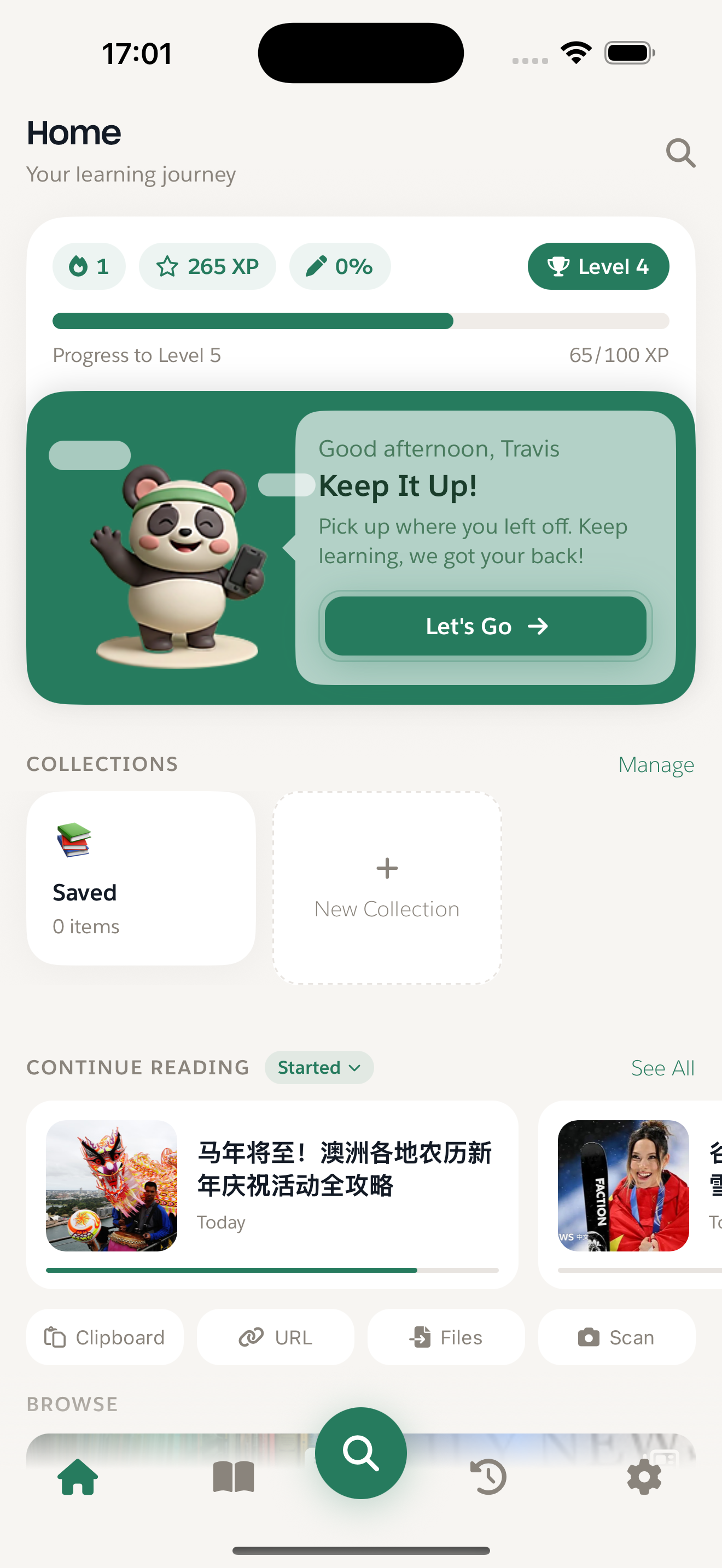
See how this works in practice — from characters to conversation.
Download free