 Hanyu
Hanyu

When you first hear about Chinese grammar, it sounds like a dream. No verb conjugation. No noun genders. No plural forms. No articles. No tense system. Compared to French with its 17 verb tenses or German with its four cases, Mandarin looks like the minimalist’s language.
And it is. The grammar is genuinely simple — in the sense that there are fewer rules. But “fewer rules” doesn’t mean “fewer ways to go wrong.” In fact, it often means the opposite.
The simplicity trap
English speakers learning Chinese tend to relax when they hear “no conjugation.” And for the first week, that confidence is justified. Want to say “I eat”? 我吃 (wǒ chī). “He eats”? 他吃 (tā chī). Same verb. No changes. Beautiful.
But then you hit particles.
了 (le). 过 (guò). 着 (zhe). 到 (dào). 完 (wán).
These tiny words attach to verbs and completely change the meaning — not by marking tense (Chinese doesn’t do that) but by marking aspect: whether an action is completed, ongoing, experienced, or a change of state.
我吃了 (wǒ chī le) — I ate / I’ve eaten (completion) 我吃过 (wǒ chī guò) — I’ve eaten (this before, as an experience) 我在吃着 (wǒ zài chī zhe) — I’m eating (ongoing right now)
All three sentences use the same verb. The particle does the heavy lifting. And the differences between them are subtle enough that English speakers constantly mix them up — because English bundles all this information into verb tense, which we do on autopilot.
Where word class breaks down
In English, words have clear roles. “Beauty” is a noun. “Beautiful” is an adjective. “Beautify” is a verb. You can tell from the form.
Chinese doesn’t work this way. The word 快 (kuài) means “fast” (adjective), but it can also mean “soon” (adverb), and in 快乐 (kuàilè) it means “happy.” The word 学习 (xuéxí) is “to study” (verb) and “study/learning” (noun) depending on position.
This flexibility is elegant once you understand it. But it means you can’t rely on word endings or markers to figure out how a sentence is structured. You have to read the position and context instead.
Chinese grammar is positional. The same word in a different slot means a different thing. That requires a different kind of attention than English speakers are used to.
Sentence order carries the meaning
Where European languages use inflection (changing word forms), Chinese uses word order. And the default order — Subject-Verb-Object — looks familiar enough that beginners feel comfortable.
But then you meet topic-comment structure, and everything shifts.
“That book, I’ve already read.” 那本书,我已经看了。(nà běn shū, wǒ yǐjīng kàn le.)
The topic (那本书, “that book”) comes first, even though it’s the object. This is perfectly natural in Chinese and sounds normal to native speakers. It’s how emphasis works. And it has no direct equivalent in standard English grammar.
Or consider:
“It’s raining.” 下雨了。(xià yǔ le.)
Literally: “descend rain [particle].” No subject at all. Chinese regularly drops subjects when they’re obvious from context. You’re not allowed to do that in English (except very informally), so it feels wrong — but it’s grammatically correct and even preferred.
The particle 了 deserves its own section
了 is the most infamous particle in Chinese, and for good reason. It has at least two major functions:
1. Completion 了 — placed after a verb to indicate the action is done. 我买了一本书。(I bought a book.)
2. Change-of-state 了 — placed at the end of a sentence to indicate something is newly the case. 他高了。(He’s gotten taller. / He’s tall now.)
Sometimes both appear in the same sentence. Sometimes the distinction between them is blurry. Native speakers use 了 intuitively and will struggle to explain why one sentence needs it and another doesn’t.
This is the kind of thing that makes Chinese grammar “simple but hard.” The rule is technically small: 了 marks completion or change. But applying it correctly in every context takes years of exposure. There’s no shortcut. You just need lots of examples.
Measure words: the hidden grammar
English has a few measure words: “a sheet of paper,” “a loaf of bread.” Chinese has them for everything. You can’t say “one book” — you say “one [measure word for flat-bound objects] book”: 一本书 (yī běn shū).
Different categories of objects use different measure words:
- 个 (gè) — general/default (people, abstract things)
- 本 (běn) — books, magazines
- 杯 (bēi) — cups of liquid
- 只 (zhī) — small animals
- 辆 (liàng) — vehicles
- 件 (jiàn) — clothing, matters
There are dozens, and using the wrong one sounds clearly off to native speakers. The good news: 个 works as a catch-all when you’re stuck, and most Chinese people will understand you. The bad news: if you want to sound natural, you need to learn the right ones.
How to approach Chinese grammar
1. Don’t study grammar in isolation. Grammar rules in Chinese are short. The difficulty is in application. Learn grammar through full sentences, not rule tables.
2. Focus on particles early. 了, 过, 着, 的, 地, 得 — these six particles account for an enormous percentage of grammar questions. Get comfortable with them through examples, not definitions.
3. Read and listen more than you study rules. Chinese grammar is pattern-based. The more sentences you absorb, the more naturally the patterns emerge. Your brain will start to “feel” when 了 is needed before you can explain why.
4. Accept ambiguity. Chinese tolerates — even embraces — ambiguity in ways English doesn’t. Context resolves most of it. If you’re the type who needs every sentence to have exactly one interpretation, Chinese will frustrate you. Let it be loose.
5. Start grammar after vocabulary. You need at least a few hundred characters before grammar study becomes meaningful. Without vocabulary, grammar rules are abstract. With vocabulary, they click into place.
Grammar in context, not in a vacuum
The best way to internalize Chinese grammar isn’t memorizing particle rules — it’s seeing them used naturally, hundreds of times, until the pattern becomes instinct. That’s something a grammar textbook can’t do well, but structured practice with real sentences can.
Hanyu pairs vocabulary with example sentences, so you don’t just learn what a word means — you see how it behaves in context. When you learn 了, you see it in five different sentences, not five different rule explanations. Over time, that exposure does what rule memorization can’t: it makes the grammar feel obvious.
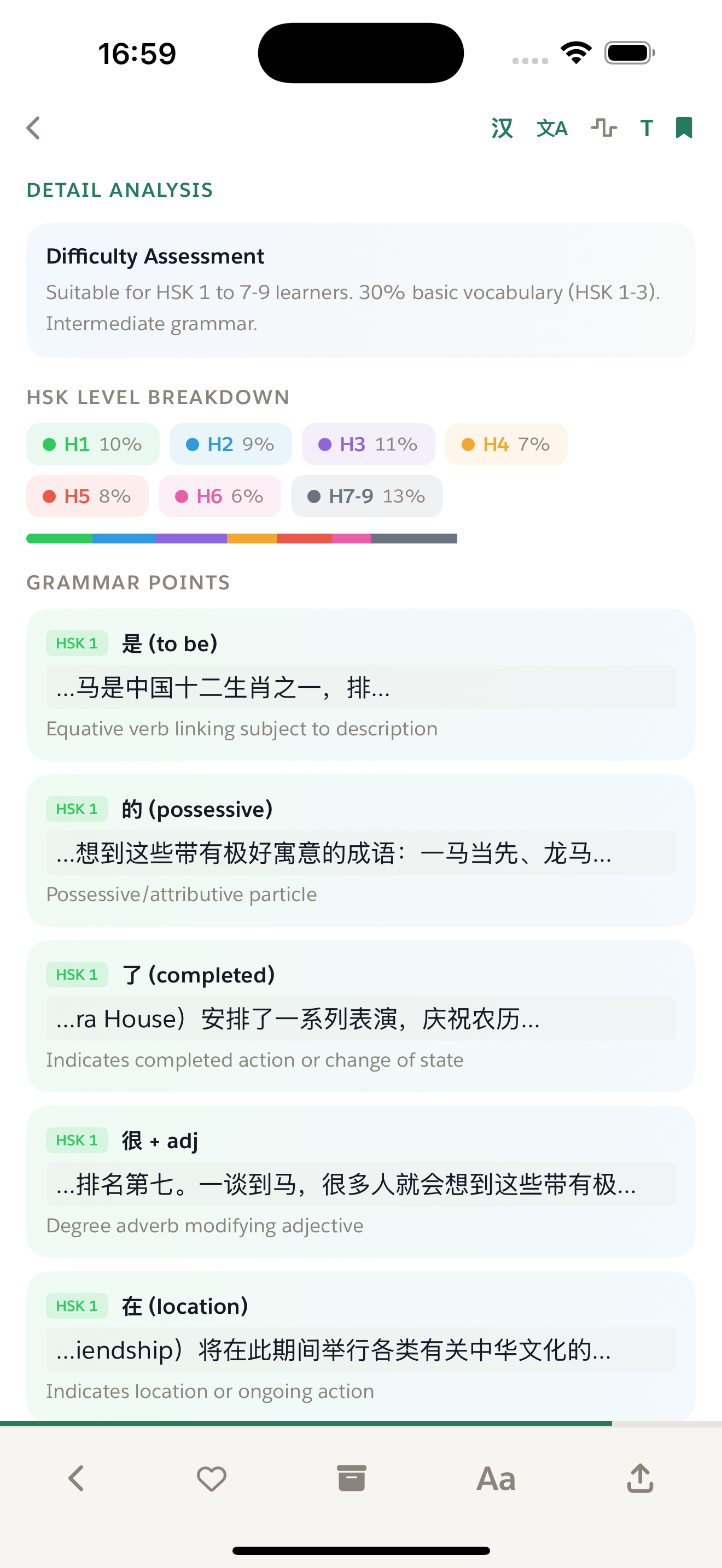
See how this works in practice — from characters to conversation.
Download free