 Hanyu
Hanyu

Learning Chinese can feel overwhelming when you see thousands of characters for the first time. But here’s the truth: you only need a handful of words to start having real interactions. These 10 words are the building blocks of everyday Mandarin, and each one teaches you something fundamental about how the language works.
1. 你好 (nǐ hǎo) — Hello
The classic. Literally “you good,” this greeting is your passport into any Chinese conversation. It also introduces you to tones — the rising-falling pattern of third tone (ǎ) is one of the first things your ear needs to learn.
2. 谢谢 (xiè xie) — Thank you
Politeness goes a long way. Notice how the second syllable is lighter — this is the neutral tone in action. You’ll hear this pattern everywhere in Chinese.
3. 是 (shì) — To be / Yes
One of the most versatile words in Mandarin. Unlike English, Chinese doesn’t conjugate verbs — 是 stays the same whether you’re talking about yourself, someone else, or a group. Welcome to Chinese grammar: it’s simpler than you think.
4. 不 (bù) — No / Not
Put 不 before almost any verb to negate it. 不是 (bù shì) means “is not.” 不好 (bù hǎo) means “not good.” One word, infinite uses.
5. 我 (wǒ) — I / Me
There’s no difference between subject and object pronouns in Chinese. 我 is both “I” and “me.” Add 们 (men) to make it plural: 我们 (wǒmen) means “we.”
6. 你 (nǐ) — You
You already know this one from 你好! Chinese doesn’t distinguish between formal and informal “you” in everyday speech (though 您 nín exists for extra politeness).
7. 好 (hǎo) — Good
Another word you’ve already seen. 好 appears everywhere: 好吃 (hǎo chī) means “delicious,” 好看 (hǎo kàn) means “good-looking.” It’s one of the most productive characters in Chinese.
8. 要 (yào) — To want
“我要咖啡” (wǒ yào kāfēi) — “I want coffee.” That’s a complete sentence. No articles, no conjugation, no filler. Chinese gets straight to the point.
9. 这 (zhè) — This
Point at something and say 这个 (zhè ge) — “this one.” You’ll use it dozens of times a day while shopping, ordering food, or asking about anything around you.
10. 多少 (duō shǎo) — How much / How many
“这个多少钱?” (zhè ge duō shǎo qián?) — “How much is this?” This single question will get you through markets, restaurants, and shops across China.
What’s next?
These 10 words aren’t just vocabulary — they’re a crash course in how Chinese works. No conjugation. No articles. Meaning built by combining simple characters in logical ways.
The best way to lock them in? Practice writing them. The physical act of tracing strokes builds a different kind of memory than flashcards alone. That’s exactly why Hanyu combines character writing practice with smart review — so every word sticks.
Ready to start? Download Hanyu and begin with these 10 words today.
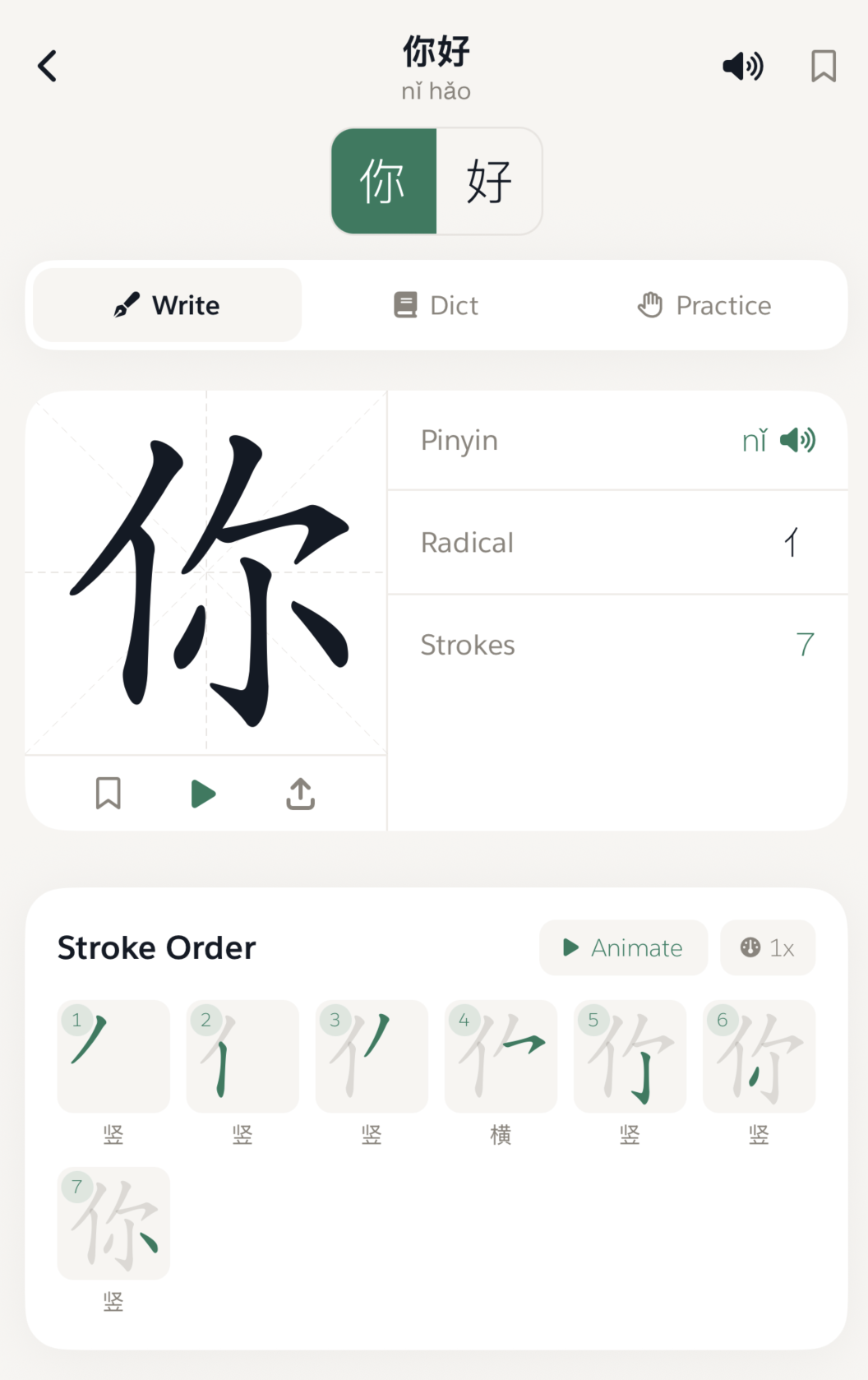
See how this works in practice — from characters to conversation.
Download free