 Hanyu
Hanyu

There’s a moment every Chinese learner hits — usually around month two or three — where you seriously consider quitting. You’ve been studying every day. You can write maybe 100 characters. You open a Chinese menu and can’t read a single dish. You see a street sign and recognize one character out of four.
Meanwhile your friend who started Spanish last month is already ordering coffee and flirting with the barista.
Here’s the thing: you’re not failing. You’re just on a different curve.
The honest truth about early progress
Chinese is front-loaded in a way that most European languages are not. With Spanish, French, or German, you share an alphabet, a huge number of cognates, and similar grammar structures. You get early wins for free.
Chinese gives you nothing for free. Every character is new. Every sound is new. The writing system has no connection to anything you’ve seen before. For the first few hundred characters, progress feels painfully slow because it is slow. Each character is a standalone investment with no obvious compound interest yet.
This is where most people quit. And it’s exactly the wrong time to quit.
What exponential actually looks like
Around 300–500 characters, something shifts. Characters you learned weeks ago start showing up inside new characters. That radical you memorized? It’s everywhere now. That phonetic component? You’re using it to guess pronunciations before looking them up.
Here’s a concrete example of how this compounds:
You learn 学 (xué, “to learn”) early on. Later you meet 学生 (xuéshēng, “student”) — you already know half the word. Then comes 大学 (dàxué, “university”), 学校 (xuéxiào, “school”), 学习 (xuéxí, “to study”). One character just gave you access to five words.
Now multiply that by every character you know. Each new one connects to ones you’ve already learned, creating a web that grows faster the bigger it gets.
By 1,000 characters, you’re not learning from scratch anymore. You’re assembling known parts into new combinations. By 2,000, you can read a newspaper headline. By 3,000, you’re reading articles with occasional dictionary lookups.
The slope doesn’t change gradually. It bends. And once it bends, it never goes back.
The HSK framework maps this curve
The HSK (Chinese Proficiency Test) levels are roughly calibrated to this exponential reality:
- HSK 1 (150 words): Survival basics. Feels like climbing a wall.
- HSK 2 (300 words): Simple sentences. Still hard. But familiar characters start repeating.
- HSK 3 (600 words): Paragraph-level comprehension. This is where the curve starts bending.
- HSK 4 (1,200 words): Comfortable daily conversation. New words feel manageable because you recognize their components.
- HSK 5 (2,500 words): Reading real content. The snowball is rolling downhill.
- HSK 6 (5,000+ words): Near-native reading. At this point, you’re learning new words from context, like a native child does.
The gap between HSK 1 and HSK 3 feels enormous. The gap between HSK 4 and HSK 6 — which is objectively much larger — feels easier. That’s the exponential curve at work.
Why this matters psychologically
The biggest threat to learning Chinese isn’t difficulty. It’s discouragement.
When you compare yourself to someone learning a European language, you’ll always feel behind — because the comparison is meaningless. Different languages have different curves. Chinese demands more upfront and returns more later. Knowing this in advance is genuine protection against quitting.
Some mental reframes that help:
“I’m investing, not spending.” Every character you learn today makes tomorrow’s characters easier. You’re building infrastructure, not just collecting facts.
“The beginning is supposed to be slow.” If it felt easy, you’d be suspicious. The difficulty is evidence that you’re doing something genuinely challenging — and that the payoff will be proportionally large.
“I don’t need all the characters.” The top 1,000 characters account for roughly 90% of written Chinese you’ll encounter in daily life. You don’t need to learn 50,000. You need to learn 1,000 really well and let the rest come naturally.
What to do in the slow phase
The first 300 characters are a grind. Accept that. But you can make the grind smarter:
1. Use spaced repetition. Don’t review everything equally. Review what you’re about to forget. This is the single most efficient technique for character retention.
2. Learn characters in context. Isolated character drilling works for the first week. After that, learn characters as parts of words and sentences. Context creates hooks that help you remember.
3. Write them. Hand-writing reinforces memory through a different channel than reading or typing. Even five minutes of stroke practice per day accelerates the early phase.
4. Track your progress visually. Keep a count. When you go from 100 to 200 characters, that’s a 100% increase. When you go from 500 to 600, that’s more characters but less effort per character. Seeing this pattern unfold keeps you going.
5. Set a milestone, not a deadline. “I will learn 500 characters” is better than “I will learn 500 characters in three months.” The first is a commitment to the process. The second is a setup for guilt.
The curve is real. Trust it.
Chinese is hard at the beginning. It gets easier. Not linearly — exponentially. The work you’re doing now, in the frustrating early stage where nothing seems to stick, is building the foundation for everything that comes later. The characters you’re struggling with today will be the effortless building blocks of tomorrow’s vocabulary.
That’s the philosophy behind how Hanyu structures your learning. Spaced repetition keeps your early characters alive without wasting time on ones you already know. New vocabulary builds on what you’ve already mastered. And because the app tracks what you know and what’s slipping, it accelerates alongside you — so the tool gets faster exactly when you do. You don’t have to trust the curve blindly. You’ll feel it happen.
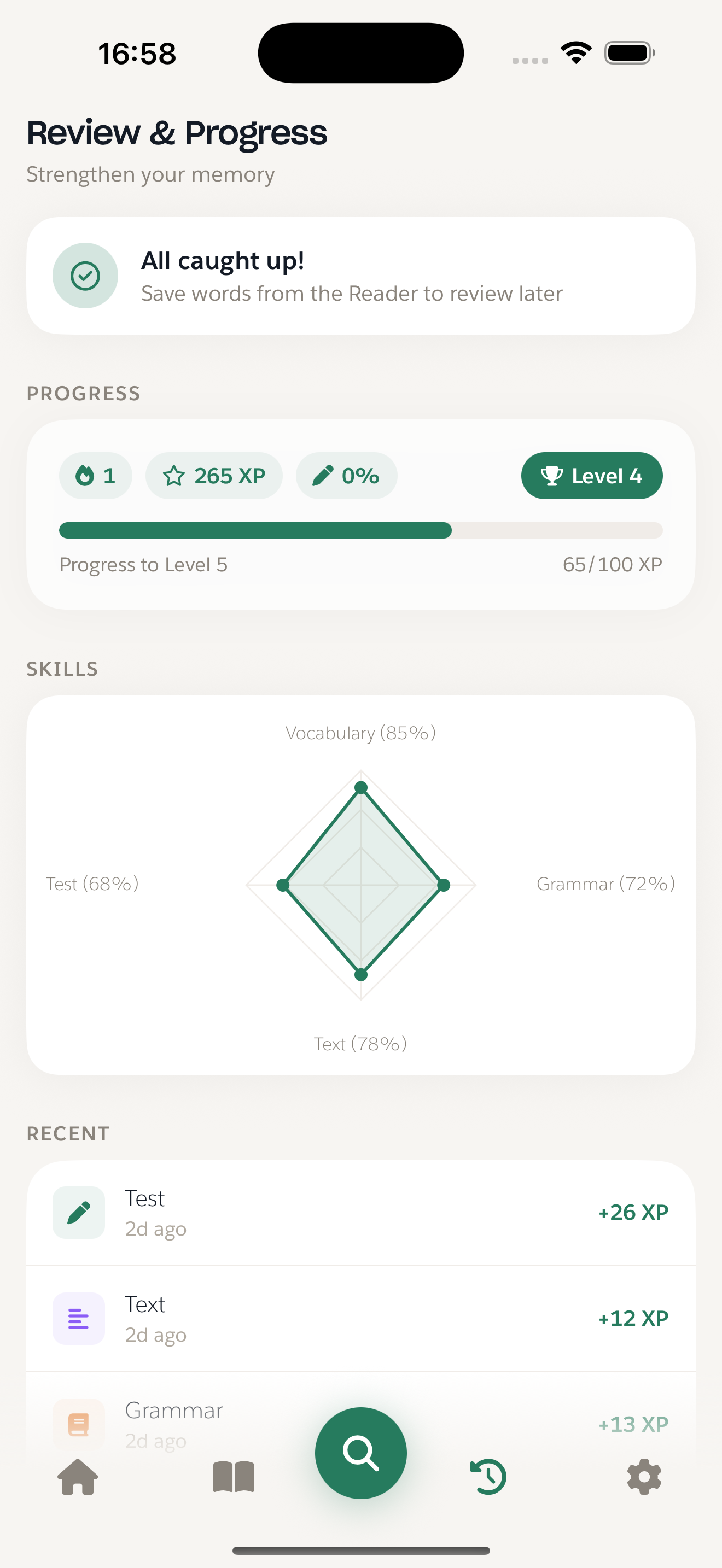
See how this works in practice — from characters to conversation.
Download free