 Hanyu
Hanyu
There are over 50,000 Chinese characters in existence. Nobody knows all of them — not even native speakers. But here’s the thing that changes everything once you understand it: those thousands of characters are built from a small set of recurring parts.
These parts are called radicals. And the most common 100 of them will transform how you see written Chinese.
What radicals actually are
A radical is a component that appears inside characters, usually hinting at meaning. The full Kangxi radical list contains 214 entries, but many are rare. The top 100 cover the vast majority of characters you’ll encounter in daily life.
Think of radicals like roots in English. If you know that “bio” means life, you can make sense of biology, biography, biome, and biopsy — even if you’ve never seen the specific word before. Radicals work the same way, but visually.
Here are a few that show up everywhere:
水 / 氵 (water) — Appears in:
- 河 (hé) — river
- 海 (hǎi) — sea
- 湖 (hú) — lake
- 汗 (hàn) — sweat
- 洗 (xǐ) — to wash
See the three dots on the left (氵)? That’s the water radical in its compressed form. Once you know it, you’ll spot it instantly — and you’ll know the character has something to do with liquid.
心 / 忄 (heart) — Appears in:
- 想 (xiǎng) — to think
- 情 (qíng) — feeling, emotion
- 忙 (máng) — busy
- 怕 (pà) — afraid
- 快 (kuài) — fast, happy
The heart radical shows up in characters about emotions, mental states, and feelings. It compresses to three strokes on the left side (忄) when it’s a component.
口 (mouth) — Appears in:
- 吃 (chī) — to eat
- 喝 (hē) — to drink
- 唱 (chàng) — to sing
- 叫 (jiào) — to call, shout
- 吗 (ma) — question particle
Anything involving the mouth — eating, drinking, speaking, shouting — often carries this radical.
The pattern is the point
You’re not memorizing 100 radicals for trivia. You’re installing a decoding system.
Most Chinese characters have two parts: a semantic component (the radical, telling you the meaning category) and a phonetic component (hinting at pronunciation). Once you can identify the radical, you’ve got a foothold on any unfamiliar character.
Take 清 (qīng, “clear/pure”). Left side: 氵 (water). Right side: 青 (qīng, “blue/green”). The water radical tells you it’s related to water. The right side tells you how to pronounce it. Two pieces of information from one character — if you know what to look for.
This works far more often than it doesn’t. Estimates vary, but roughly 80–90% of Chinese characters follow this semantic-phonetic pattern. That’s not a coincidence. It’s the design principle of the writing system.
Why this stage is hard (and worth it)
Let’s be honest: the radical learning phase can be a grind. You’re memorizing components that don’t feel useful yet because you haven’t seen enough characters to appreciate the patterns.
It’s like learning the periodic table before you do any chemistry experiments. Necessary, but boring in isolation.
Here’s how to make it less painful:
1. Learn radicals through characters, not lists. Don’t memorize 氵 in a vacuum. Learn it by meeting 河, 海, and 洗 — words you’ll actually use.
2. Focus on the top 50 first. These appear in the majority of everyday characters. The remaining 50 can come gradually.
3. Look for radicals in characters you already know. You probably recognize 妈 (mother). See the 女 on the left? That’s the woman radical. It’s in 姐 (older sister), 妹 (younger sister), and 她 (she). You already knew this radical — you just didn’t have a name for it.
4. Group characters by radical. When you notice that 说 (speak), 话 (speech/language), and 读 (read) all share the speech radical 讠, that’s not coincidence. It’s a pattern you can use.
The 20 you should learn first
If you want a starting point, these radicals appear most frequently in beginner-level characters:
| Radical | Meaning | Example |
|---|---|---|
| 人 / 亻 | person | 你 (you), 他 (he) |
| 口 | mouth | 吃 (eat), 喝 (drink) |
| 女 | woman | 妈 (mother), 她 (she) |
| 水 / 氵 | water | 河 (river), 海 (sea) |
| 心 / 忄 | heart | 想 (think), 快 (fast) |
| 手 / 扌 | hand | 打 (hit), 拿 (take) |
| 日 | sun/day | 明 (bright), 时 (time) |
| 月 | moon/month | 朋 (friend), 明 (bright) |
| 木 | tree/wood | 林 (forest), 本 (origin) |
| 火 / 灬 | fire | 热 (hot), 煮 (boil) |
| 土 | earth | 地 (ground), 城 (city) |
| 金 / 钅 | metal | 银 (silver), 铁 (iron) |
| 言 / 讠 | speech | 说 (speak), 话 (words) |
| 食 / 饣 | food | 饭 (rice), 饿 (hungry) |
| 足 | foot | 跑 (run), 路 (road) |
| 目 | eye | 看 (look), 睡 (sleep) |
| 耳 | ear | 听 (listen) |
| 门 | door/gate | 问 (ask), 间 (space) |
| 刀 / 刂 | knife | 切 (cut), 别 (don’t) |
| 大 | big | 天 (sky), 太 (too) |
You don’t need to memorize this table right now. But bookmark it. As you learn characters, come back and check — you’ll be surprised how often these 20 radicals explain what you’re looking at.
From chaos to logic
Chinese characters look like random drawings to beginners. That’s because you’re seeing the finished product without understanding the blueprint. Radicals are the blueprint. Learn them, and characters stop being shapes you memorize — they become structures you read.
That shift is what separates struggling learners from people who actually enjoy the process.
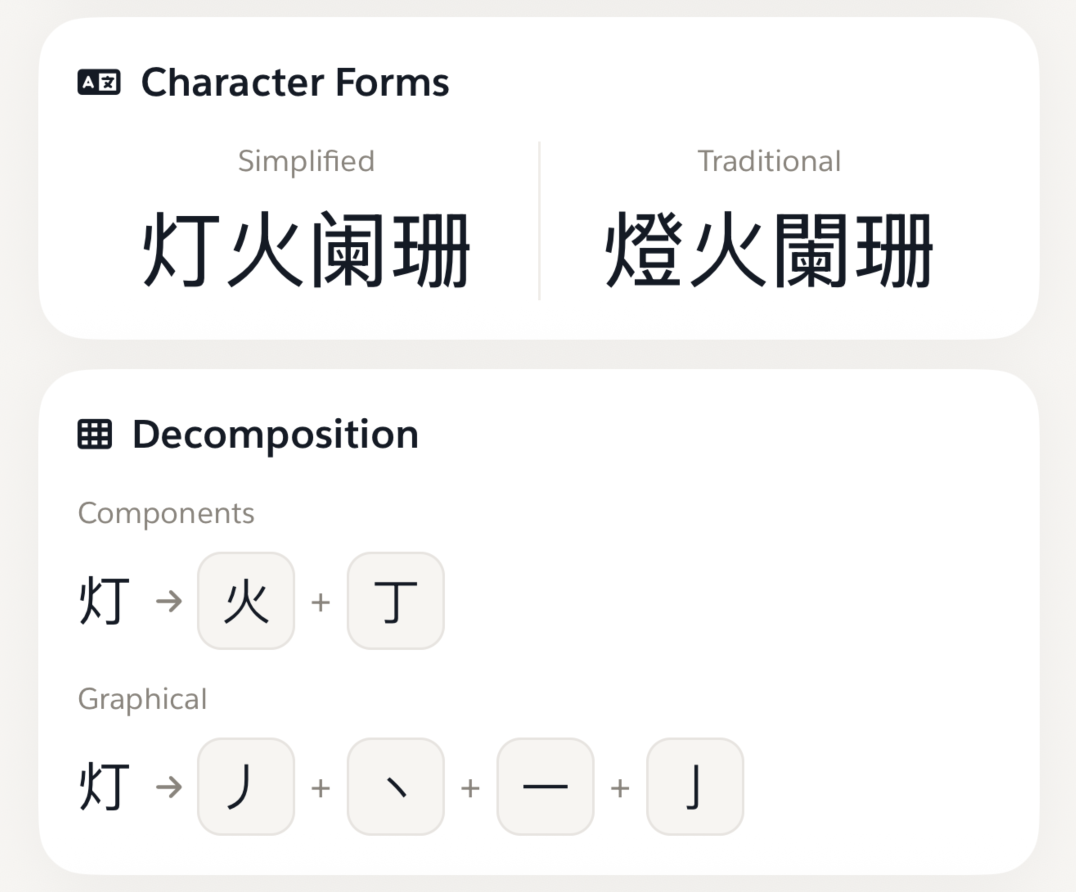
If you want to see this in action, Hanyu breaks down characters into their building blocks as you learn them. Instead of staring at a character trying to brute-force it into memory, you see the radical, the components, the logic. It turns every new character into a puzzle you already have most of the pieces for — and that makes the whole journey feel a lot less like grinding and a lot more like discovery.
See how this works in practice — from characters to conversation.
Download free