 Hanyu
Hanyu

You can type Chinese without knowing how to write a single character. Just type pinyin on your phone, pick the right character from the suggestion list, and you’re done. Millions of native speakers do exactly this every day.
So why bother writing by hand?
Because typing and writing train completely different parts of your brain. And when you’re learning Chinese — not just using it — that difference matters more than you’d think.
The stroke order argument
Chinese characters are built from individual strokes. A horizontal line. A vertical line. A dot. A hook. There are about 30 basic strokes, and every character in the language — all 50,000+ of them — is some combination of these strokes written in a specific order.
Stroke order isn’t arbitrary calligraphy tradition. It exists because it makes characters faster and more consistent to write. Top to bottom, left to right, outside to inside. Once you internalize the pattern, new characters become predictable. You stop thinking about where each line goes and start recognizing why it goes there.
That recognition is the real payoff.
Handwriting builds structural awareness
When you write 想 (xiǎng, “to think”) by hand, you physically experience it as three parts stacked together: 木 (wood) + 目 (eye) + 心 (heart). Thinking comes from the heart, through the eyes, rooted like a tree. That’s not just a mnemonic — it’s how the character was designed.
You can learn this intellectually by reading about it. But tracing the strokes with your hand — feeling 心 as the base, noticing 目 sitting inside a larger frame — creates a spatial memory that reading alone doesn’t.
This is why handwriting helps you remember characters, not just recognize them. Recognition is passive (“I’ve seen this before”). Memory is active (“I can produce this from nothing”). The gap between those two is where most learners get stuck.
What research says
Studies on Chinese-as-a-second-language learners consistently show that handwriting practice improves character recognition and recall compared to typing-only approaches. The motor act of writing — the physical sequence of strokes — creates an additional encoding pathway. You’re not just seeing the character. You’re feeling it.
This isn’t unique to Chinese. Research on English-speaking children shows similar benefits for handwriting versus keyboard use. But the effect is amplified with Chinese because characters are inherently spatial — they’re two-dimensional arrangements, not linear strings of letters.
You don’t have to write everything
Let’s be practical. You’re not going to hand-write every character you learn. That would be impossibly slow. But there’s a middle ground that works:
- Write new characters by hand when you first learn them. The initial encoding matters most.
- Focus on high-frequency characters. The first 500 characters cover roughly 80% of everyday written Chinese. Those are worth the hand practice.
- Trace, don’t just copy. Following stroke order guides is more effective than free-writing, especially early on.
- Don’t obsess over beautiful handwriting. The goal is structural memory, not calligraphy.
After the initial learning phase, typing is fine for daily use. The handwriting is for learning. They serve different purposes.
Strokes reveal radicals, radicals reveal meaning
There’s a cascading benefit to handwriting that shows up later. Once you’ve written enough characters, you start automatically noticing the building blocks inside them. The water radical (氵) in 河 (river), 海 (sea), 湖 (lake). The mouth radical (口) in 吃 (eat), 喝 (drink), 唱 (sing).
These radicals aren’t just trivia. They’re a decoding system. When you encounter a character you’ve never seen, the radical gives you a hint about meaning category. The other component often hints at pronunciation. Handwriting is what trains your eye to spot these components quickly, because you’ve physically built them stroke by stroke.
The convenience trap
Pinyin input is frictionless. That’s its strength and its danger. When you type “hé” and pick 河 from a list, you’ve made a recognition decision — but you haven’t engaged with the character’s structure at all. Do that a thousand times and you’ll be fast at selecting characters but slow at recalling them.
Handwriting adds friction — and friction is where learning happens.
Putting the pen to work
If you’re serious about retaining characters long-term, build writing into your practice. Even 10 minutes a day makes a real difference — especially in the first few months when your character foundation is still forming.
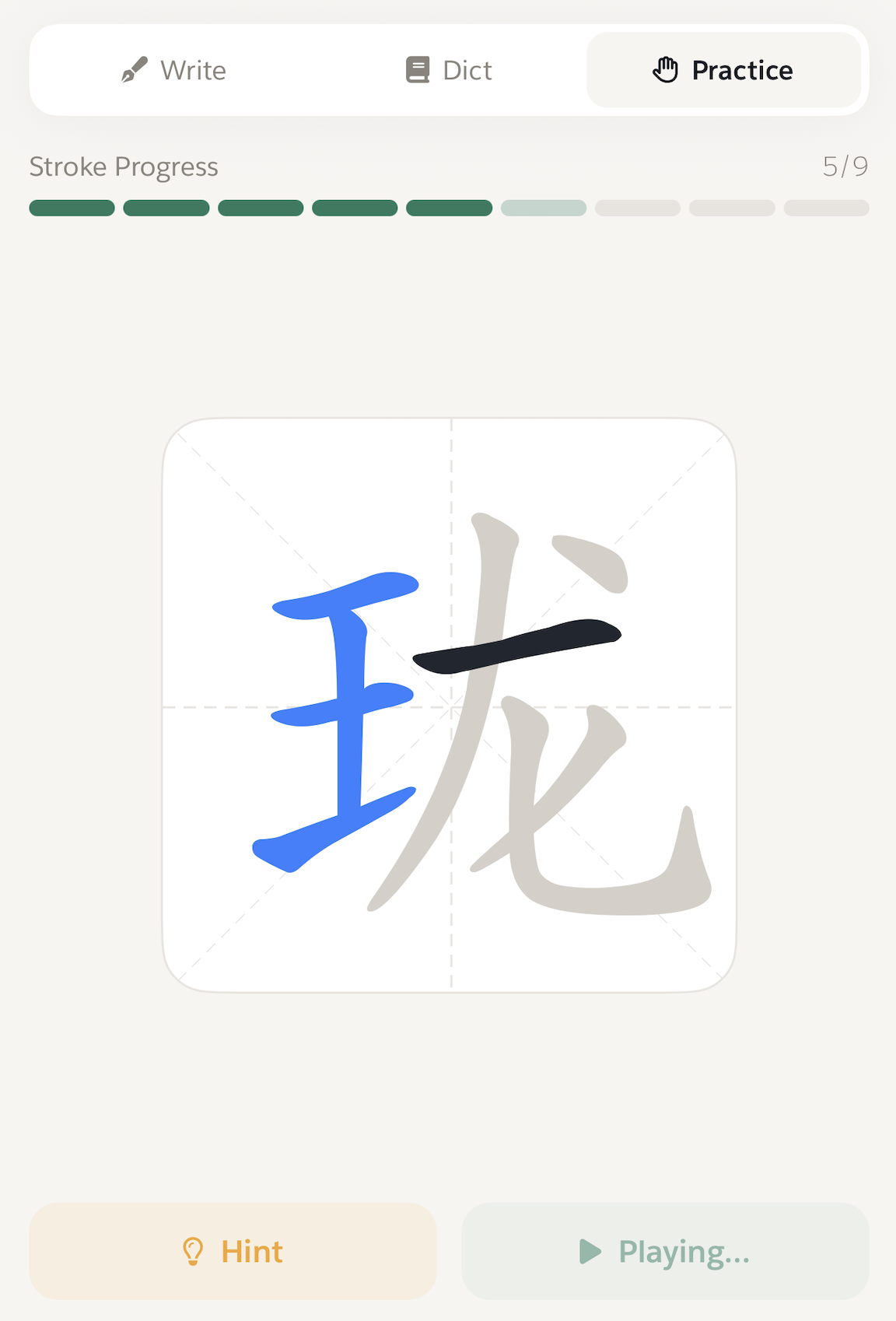
That’s exactly why Hanyu includes character writing practice as a core feature, not an afterthought. You trace strokes on screen with guided feedback, so the muscle memory builds alongside your vocabulary. It’s the closest thing to pen-on-paper practice you can do on a phone — and it means every word you learn gets encoded through your hand, not just your eyes.
See how this works in practice — from characters to conversation.
Download free